What Is AI, Really?
We often talk about AI like it’s just one thing.
It isn’t.
When you use ChatGPT, an AI assistant, a customer service bot, or an AI agent, you’re seeing the finished product. Behind the scenes, many technologies, data sources, models, integrations, rules, and systems work together.
It’s like ordering a meal at a restaurant. You see the final dish, but you don’t see the ingredients, recipes, kitchen tools, suppliers, chef, prep steps, or the health and safety rules that made it happen.
AI works in much the same way. What we call “AI” is just the finished dish.
How the Pieces Fit Together
Here are the building blocks, listed in the order they rely on each other:
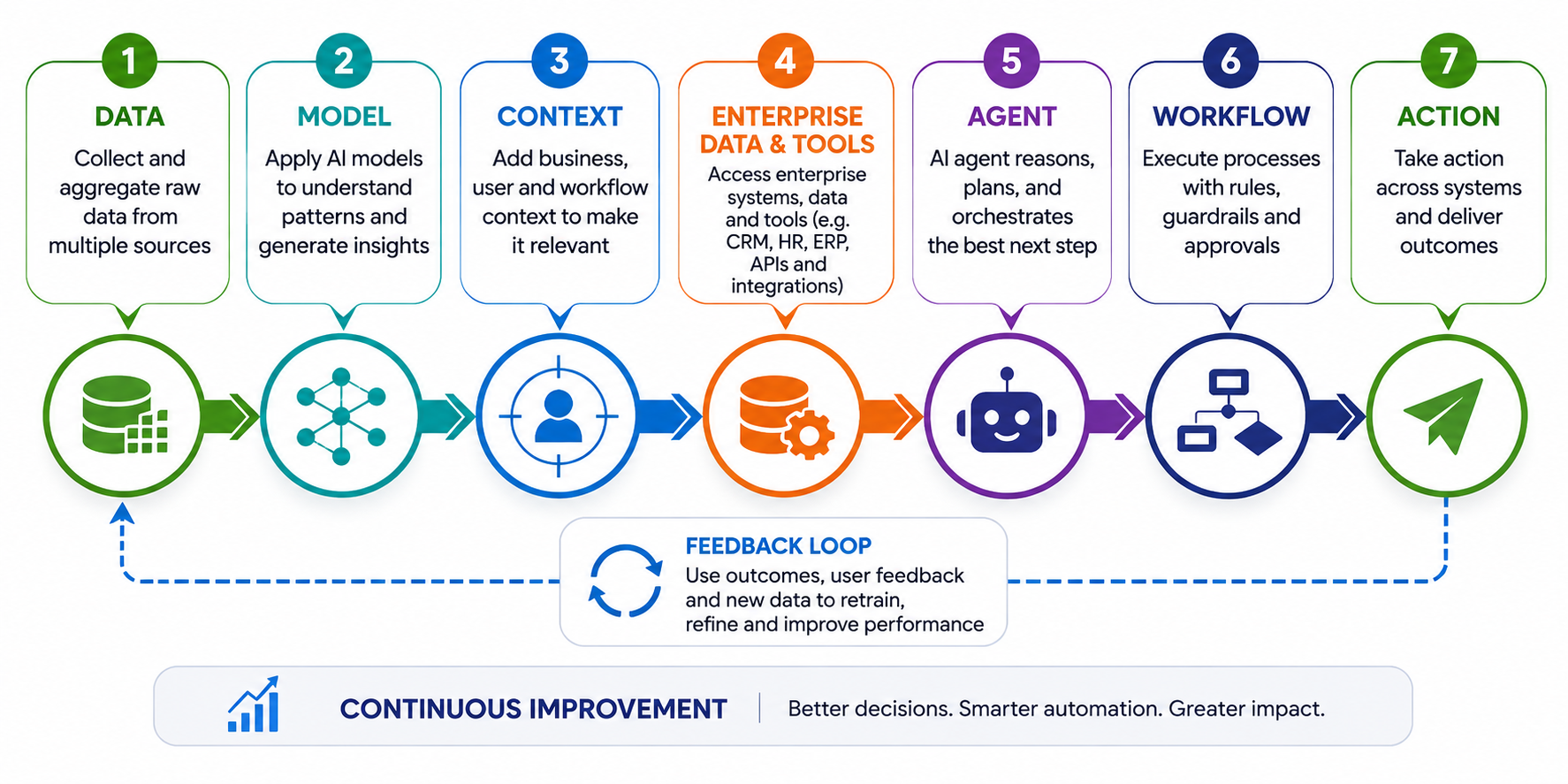
How an AI system fits together, from data and models through context, enterprise data and tools, AI agents, workflows and actions, with governance and continuous improvement throughout.
Governance is present at every stage.
It Starts with Data
AI starts with data. Text, documents, conversations, images, transactions, customer records, product details, and many other sources can all be used to build or support an AI system.
During training, huge amounts of data are analyzed so the model can spot patterns and relationships. The model doesn’t memorize everything like a giant filing cabinet. Instead, it learns statistical patterns that help it make predictions.
That difference matters. AI isn’t a database of answers, and it doesn’t think like a person. The model figures out what’s most likely to come next based on patterns it has learned. When I mention a model’s reasoning, I mean pattern-based inference. It’s powerful and often very useful, but it’s not human thinking.
This is also why AI can sound confident even when it’s wrong. A model gives the answer that sounds most likely, not always the right one, and it sounds just as sure either way. Most of what comes next context, enterprise data, tools, and governance—exists to manage that risk.
Then Comes the Model
A model is a mathematical system trained to find patterns in data. Many kinds of AI models exist, each designed for different jobs like recognizing images, forecasting demand, spotting fraud, understanding language, and more.
Large Language Models, or LLMs, are one example. ChatGPT, Claude, Gemini, and others use these models. An LLM is trained on massive amounts of language and is great at understanding and generating text.
But the LLM is just one part of the whole AI system.
The Prompt Is Only the Beginning
We hear a lot about prompts. A prompt tells the AI what we want, but the context around it is becoming just as important.
Who is the user? What are they trying to accomplish? What conversation has already taken place? What company policies apply? What customer information is relevant? Which documents should the AI reference?
Context helps turn a general-purpose model into something useful for a specific situation. That’s why enterprise data is so important.
The underlying model may be available to everyone.
But your organization’s knowledge isn’t.
Giving AI Access to Knowledge
Suppose a customer asks an airline: “Can I change my ticket?”
A general-purpose LLM understands the question, but it doesn’t automatically know that customer’s ticket type, loyalty status, fare rules, flight information, or the airline’s current policies.
The AI needs access to reliable information. That’s where enterprise systems, APIs, retrieval tools, and integrations come in.
The AI might pull up the customer’s reservation, check the fare rules, read the airline’s policy, and then use the language model to explain the answer in plain language.
At that point, it’s more than just an LLM.
We’re looking at a full AI system.
From Answering Questions to Taking Action
This brings us to AI agents.
An agent combines a model’s reasoning and language skills with access to tools and systems. Instead of just saying, “Your flight can be changed,” an agent could pull up your booking, check available flights, calculate the fare difference, show you the options, change the reservation, send a confirmation, and update the CRM. That’s why agents are getting so much attention.
AI is shifting from just giving information to doing work.
What the Flow Looks Like in Practice
Here are those same building blocks in motion:
Customer asks a question, the LLM understands the request, enterprise knowledge provides context, the agent picks the right tools and follows the workflow, systems act, and AI shares the result.
All around that process, you need:
Identity • Permissions • Security • Governance • Human Oversight
Where Do Workflows Fit?
Agents don’t replace workflows; they work alongside them.
A workflow sets out how work moves through an organization, including approvals, routing, business rules, integrations, exceptions, and handoffs. An agent might choose which workflow to use, gather the needed information, or complete several steps on its own.
That’s why it’s important to know the difference between an LLM and an AI agent. The LLM provides language and reasoning, the tools connect to other systems, and the workflow adds structure. The agent brings all these parts together to get the job done.
And Then There Is Governance
This might not be the most exciting part of AI, but it’s probably one of the most important.
Once AI can access corporate information and take actions, organizations must make some fundamental decisions. What information can the AI see? Which systems can it access? What actions can it perform? When does a human need to approve something? What happens if the AI is uncertain? How are decisions recorded and audited? How do we protect sensitive customer information?
Those questions are all about permission. There’s another set about performance: how do you know the system is doing what you expect? That means testing before launch, monitoring afterward, and agreeing ahead of time on what “working” really means. Governance without measurement is just a policy document.
Governance isn’t something you tack on after building the AI system. You need to build it in from the start.
The more freedom we give AI, the more important governance becomes.
The question is no longer: “What can the AI say?”
Increasingly it is: “What is the AI allowed to do?”
Three Ways to Make a Model Yours
Once you know which knowledge matters, there are three main ways to use it, and they build on each other.
The first is prompt and context: telling the model what you want and giving it the right situation when you ask. It’s fast, it’s cheap, and it’s where most organizations begin.
The second is retrieval: connecting the model to your own systems and documents so it can look things up before answering. This is often called RAG, or retrieval-augmented generation, and it’s how most enterprise AI works today. The airline example above is just that.
The third is fine-tuning or training your own model: adjusting the model with your own data, so the behavior is built in instead of added each time you ask. It costs more and takes more effort, but it gives you something a competitor can’t just buy.
Most organizations today use the first two. The third is where ownership gets interesting.
Who Owns All of This?
Organizations are also beginning to face another question: Who should assemble and control the AI stack?
Going back to the restaurant analogy, one option is to use a fully assembled kitchen. A vendor provides the models, data services, tools, orchestration, integrations, security, and governance framework. The main benefit is simplicity.
Another way is to build your own kitchen. An organization might use one company’s foundation model, another’s data platform, its own apps, specialized AI models, and different agent or orchestration tools. This approach gives you more flexibility and possibly more control.
Neither approach is always right, and most organizations use a mix of both.
Organizations might use commercial foundation models but keep control of the intelligence that’s unique to their business.
That enterprise-specific knowledge, like customer history, processes, policies, intellectual property, and company expertise, may be where the real competitive advantage lies.
We are already seeing developments that point in this direction. River AI, founded by xAI co-founder Igor Babuschkin, recently raised $1.1 billion, led by General Catalyst, with investment from Nvidia and AMD Ventures to help enterprises train and control their own models. It raises interesting questions about model customization, enterprise data, and who ultimately owns and controls an organization’s AI intelligence.
The bigger idea is that the future of enterprise AI isn’t just about picking a major foundation model or building everything from scratch. It’s about deciding which parts of the AI stack you use, which parts you customize, and most importantly, which parts of your intelligence you need to own and control.
So, What Is AI?
AI isn’t just one model. It’s not ChatGPT. It’s not an agent. And it’s not magic.
It’s a collection of technologies working together.
Data gives AI something to learn from. Models find patterns. LLMs provide language and reasoning skills. Context makes responses relevant. Enterprise data adds unique knowledge. Tools let AI interact with systems. Agents organize decisions and actions.
Workflows provide structure. Governance sets the rules for what the system can know and do.
And people are still responsible for the outcome.
That last point might be the most important.
Businesses aren’t really buying AI.
They’re buying an outcome.
That outcome might be a better customer experience, less effort, faster service, better decisions, higher productivity, more revenue, or lower risk. AI is becoming another powerful way to reach those goals.
Maybe the better question isn’t: “What AI are we using?”
It’s: “What problem are we trying to solve, and how should all these pieces work together to solve it?”